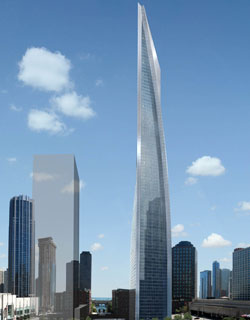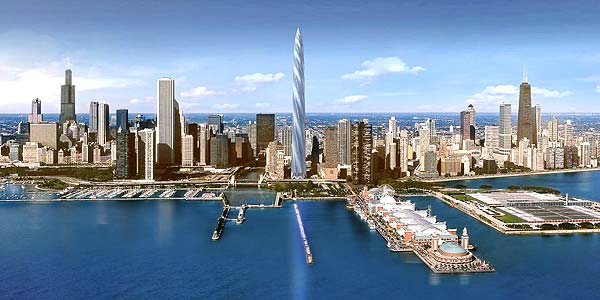
The world’s tallest residential building, the Chicago Spire, is under construction near Navy Pier in Chicago. Chicago is already home to the current tallest residential building in the world, the John Hancock Building, built in the 1970s (all of the more recent “tallest” buildings have been purely commercial). The Hancock is a mixture of residential and commercial however. The Spire would be solely residential. The Spire dwarfs even the Hancock in size however. It is double the size of the 45th tallest residential building in the world, the recently completed 340 on the Park at 340 E. Randolph.
Yesterday was supposed to be the grand opening of the Spire’s sales center but that has now been pushed off until January 2008. Instead, the developer held a “sneak peek” look at the project for realtors and the media.
The Irish developer, Shelbourne, has made no secret of the fact that they are marketing the units aggressively to overseas investors. They have a separate real estate agency handling sales specifically for the overseas market. At more than $1000 per square foot, these would be among the most expensive units on the market in Chicago. And you’re going to have to sell a whole heck of a lot of them to get the building built. There will apparently be 1200 units.
Even with a healthy economy, Chicago doesn’t come close to the money found in London or New York. Hence, the reason that the developer is pushing them to foreign investors. And with the dollar trading so weak to the Euro and the British pound, you’re essentially buying a unit at nearly 50% off.
Problem is, apparently Chicago is not seen as a world class city by the Europeans. The London Telegraph recently discussed the problems with “selling” the Spire overseas:
Yet investing in this premium-priced tower designer skyscraper, in the US where many property prices are falling, and in a city largely unknown to British investors, may well appeal only to the brave. Conventional wisdom urges investors to buy lower-cost properties in established markets with limited supply.
The Spire’s story so far may also make investors nervous. The original developer failed to win funding so dropped the scheme, rival developer Donald Trump claims the Spire may be a terrorist target, and the Calatrava design has seen late changes including the removal of a proposed hotel. The Chicago Times newspaper has suggested that a shorter tower could be built on the Spire’s existing foundations if the full scheme is scaled back.
Will the Olympics be a major impetus to putting Chicago on the map internationally? Maybe. If Chicago gets the games.
The units will seem cheap compared to their European counterparts (heck, even to their New York counterparts.) But “cheap” is relative.
Official prices are being kept secret ahead of a four-month marketing campaign prior to the units going on sale in January 2008. But Sherbourne hints the apartments may cost around a quarter of their central London equivalents.
“Prices fetch £3,000 per square foot in central London and £2,500 in Manhattan, and the Spire will cost only a fraction of that,” says Savills director Ed Lewis. He promises each apartment will be big: “Americans like their elbow room. Even a studio will be 750-800 sq ft, some 15 to 20 per cent larger than in the UK.”
What will a building be like that is nearly all owned by investors? What will that contribute to the community if there are few Chicago residents actually living in the building? Or they are all, simply, renters? No one seems to be asking these questions.
Sales at the high end have definitely slowed. Trump still has quite a few units for sale. Waterview Tower is the same story. The Ritz is also apparently only 40% sold. What about Canyon Ranch? No one talks about its sales. And on and on and on (in the upper bracket.) The agents act as if the boom will go on forever:
“Chicago remains pretty strong and has certainly not suffered in the way some markets have – for example San Diego and Boston,” says Chris Gaggero, an English estate agent who works for @Properties, a realtor in the city.
“The Trump Tower, which added a lot of inventory to the high-end downtown market in Chicago, doesn’t seem to have created a drag,” Gaggero adds. He points out, however, that the number of top-end apartments already on sale in downtown Chicago is 15 per cent up on the figure two years ago. Prices in this sector have risen only one per cent since 2005.
Conveniently, the agent giving the “all is well” quote is from @properties, the realtors chosen as the marketing agency for the Spire in the United States. What are they going to say- that it will never sell? Of course not. Interesting statistic, though, that prices in the upper bracket haven’t really gone up at all in nearly three years. The article lists the pros and cons of investing in the Chicago Spire. Do you agree?
Pros and cons of investing in the Chicago Spire
PROS
• Architectural landmark
• Developer keen to woo British buyers
• Exchange rate
• Ripe for corporate letting
• City set to boom long term
CONS
• High price
• Tall towers are not always popular with renters
• Well-publicised problems in US housing market
Prices at the Spire haven’t officially been announced yet but numbers that have been floating around put the range at $750,000 to $10,000,000.